


PoE, short for Power over Ethernet, is a technology that enables power supply and data connection over a single cable. It eliminates the need for separate power supplies or electrical power outlets for network devices, making network installation more accessible and efficient. Using spare pairs of network cables, PoE technology delivers electrical power to network devices, such as security cameras, IP phones, wireless access points, and industrial applications.
Benefits of PoE
Time and cost savings
PoE can reduce the time and expense of having electrical power cabling installed. Network cables do not require a qualified electrician to install. Reduction of power outlets required per installed device saves money. It also reduces energy costs by allowing for centralized control over lighting, window shades, and heating and cooling.
Flexibility
Without being tethered to electrical outlets, devices such as monitors, security cameras, and wireless access points can be positioned in ideal locations and be easily repositioned if moved.
Safety
Power delivery using PoE is designed to intelligently protect network equipment from overload, underpowering, and incorrect installation. It also eliminates the danger of working with or around dangerous high-voltage power sources.
Reliability
PoE power comes from a central and universally compatible source and not from a collection of distributed wall adapters. It can be backed up by an uninterruptible power supply (UPS), allowing for continuous operation even during power failures. PoE also allows for devices to be easily disabled or reset from a centralized controller.
Scalability
Having power available on the network means that the installation and distribution of network connections are simple and effective.
-
![60W Passive POE Injector RJ45 Wifi Adapter For CCTV Security Camera VOIP Ethernet Switch Antenna]()
-
![Single-port 10/100/1000Mbps 120W Wall Mount Over Ethernet Adapter POE Injector]()
-
![24W Wall Mount Over Ethernet Adapter PoE Injector]()
24W Wall Mount Over Ethernet Adapter PoE Injector
Add to Inquiry -
![24W Wall Mount Over Ethernet Adapter POE Injector]()
24W Wall Mount Over Ethernet Adapter POE Injector
Add to Inquiry -
![Wall Plug Power Over Ethernet Adapter 2*10/100Mbps POE RJ45 Injector]()
-
![Gigabit PoE Injector, 802.3af/at/bt 60W]()
Gigabit PoE Injector, 802.3af/at/bt 60W
Add to Inquiry -
![GIgabit Power Over Ethernet Active PoE Injector 60W POE]()
GIgabit Power Over Ethernet Active PoE Injector 60W POE
Add to Inquiry -
![UK Plug DC24W POE (Power Over Ethernet) Injector]()
UK Plug DC24W POE (Power Over Ethernet) Injector
Add to Inquiry -
![US Plug DC24W POE (Power Over Ethernet) Injector]()
US Plug DC24W POE (Power Over Ethernet) Injector
Add to Inquiry




Why Choose Us
Advanced Equipment
Our equipment include High-frequency welding machine, USB Auto welding machine, USB 3.1 Haba welding machine, laser welding machine, laser cutting machine, temperature and humidity cycle tester, salt spray tester, SGS Test Machine, Connector Insert Force Tester, Network Analyzer, IP67 Waterproof tester.
Wide Product Range
Its product series include peripheral connecting cables for Computer, Automobile, Aviation, Medical and other fields. At the same time, in order to meet the growing demands of customers, the company also manufactures a variety of special customized products.
Complete Qualifications
The company has passed the ISO9001:2015, ISO14001:2015 and the USB3.1 series, certification as a member of the HDMI association. Meanwhile, we own a lot of advanced production equipment and quality inspection equipment to improve production efficiency, product consistency and quality stability.
Professional Technical Team
Kaiwin has 10 modern production lines, employs about 350 workers and covers an area of 9000㎡, with an annual production capacity of about 10 million pcs. We have a team of excellent technical personnel with more than 10 years of experience.
To operate properly, PoE (Power over Ethernet) relies on two crucial components: the power sourcing equipment (PSE) and the powered device (PD). The PSE acts as a power source, integrating electrical power with data before transmitting them into the network system, whereas the specific amount of power it can deliver depends on the PoE standard we mentioned earlier. On the other hand, PD refers to any devices that leverage PoE technology to receive both power and data through the same Ethernet cable. Moreover, there are two ways a PSE can supply power, either through an endspan (Mode A) configuration with PoE switches or a midspan (Mode B) configuration with PoE injectors.
The 4 Main PoE Types



Type 1 (802.3af Standard)
Simply known as “PoE'', the original Type 1 standard was first introduced by the IEEE in 2003. It uses two wire pairs in the Ethernet cable for power delivery and the other two for data transmission, delivering up to 15.4W (watts) of power, leaving around 12.95W for the powered devices.
Type 2 (IEEE 802.3at Standard)
Type 2 PoE+, came out in 2009 with a significantly boosted power output of 30W, whereas the power received by the connected devices is typically 25.5W. Just like Type 1, it uses two pairs of wire respectively for transmission of power and data in the Ethernet cable.
Type 3 (IEEE 802.3bt Standard)
Type 3 PoE++ can also be referred to as 4PPoE (Four-Pair Power over Ethernet) or Ultra PoE. It was standardized in 2018 and utilizes all four pairs in the Ethernet cable for power and data delivery, increasing power levels to 60W, while the connected devices receive up to 51W.
Type 4 (IEEE 802.3bt Standard)
Type 4 PoE++ was released alongside the Type 3 version in 2018. Similarly, it has the common name of 4PPoE, and it also leverages all four pairs in the Ethernet cable for transmission, but it boasts an even higher maximum output level, up to 100W, with the connected devices receiving around 71.3W after cable dissipation.
What Powered Devices can be Used for PoE?

IP Cameras
IP cameras are popular for surveillance and security. PoE simplifies their installation by eliminating the need for separate power sources, making it easier to place them in locations without nearby power outlets.
Wireless Access Points (WAPs)
WAPs provide Wi-Fi connectivity, essential for creating wireless networks in homes, offices, and public spaces. PoE-enabled WAPs benefit from centralized power management and easier installation in places without power outlets.
VoIP Phones
VoIP phones use PoE to receive power and data, making deployment in office environments more straightforward. PoE reduces cable clutter and enhances reliability by centralizing power delivery.
LED Lighting
PoE lighting systems use Ethernet cables to provide both power and data to LED light fixtures. This allows for advanced lighting control, energy efficiency, and simplified wiring compared to traditional electrical systems.
What Types of Ethernet Cables are Used in PoE?
Ethernet cables are the key player in PoE systems and the choice of cable can significantly impact the network’s performance and reliability. Key considerations for PoE network cables include
Cable Type
Higher category cables (Cat5e, Cat6, Cat6a, and Cat7) offer better performance, including higher data rates and improved noise resistance. Cat6a and Cat7 cables are recommended for higher power PoE applications (up to 100W) to minimize voltage drop and heat buildup.
Cable Quality
High-quality cables with proper shielding and insulation reduce interference and ensure reliable power delivery. Shielded Twisted Pair (STP) cables provide additional protection against electromagnetic interference (EMI), which is important in environments with high electrical noise.
Cable Length
While standard Ethernet cables support lengths up to 100 meters, longer runs can lead to power loss and data signal degradation. PoE extenders can mitigate these issues, allowing for extended cable lengths while maintaining performance.
Common Applications of PoE
Security Systems: PoE can be used to power IP cameras and access control systems. This allows flexible and strategic placement of security devices, enhancing the security coverage in facilities with limited power sources.
Voice over Internet Protocol (VoIP): By reducing reliance on nearby power outlets, PoE enables deployment of VoIP phones in remote areas, facilitating steady voice communication across the network.
Wireless Access Points: PoE can help extend Wi-Fi coverage, especially in locations where installing new power lines might be difficult or expensive, ensuring seamless connection throughout the facility.
Building Automation: PoE simplifies the installation of smart building devices, such as contact detectors, humidity sensors, alarm control systems, etc, no matter the amount of electrical outlets available on site.
Retail Displays: PoE can supply power for digital signage and interactive kiosks, eliminating the need for separate power supplies, thus reducing cable clutter and creating a cleaner aesthetic in retail environments.
Manufacturing Execution System (MES): In manufacturing, PoE can power devices that monitor and control production processes, such as Advantech's HMI Terminal, streamlining data collection on the factory floor.
Factory Automation: Factories can deploy devices like Advantech’s PoE sensing gateways to seamlessly integrate various sensors and devices in the production line, boosting the overall efficiency of operations with centralized power management.
Intelligent Transportation System (ITS): PoE can offer a reliable data communication network for ITS devices, like traffic monitoring cameras or rail communication systems, even if power sources are limited in the area. However, it is important to use PoE switches that can withstand shock and vibration, such as Advantech's EN 50155 model, to ensure smooth operation in these applications.

What is the Maximum Distance of PoE?
PoE can transmit 100 meters from the switch or hub to the Network interface controller (NIC), regardless of where the power is injected. The limitation is not the power; the Ethernet cabling standards limit the total length of cabling to 100m, the furthest distance a PoE switch can transmit simple data over Ethernet. A PoE Ethernet extender, however, can lengthen that span up to 4,000 feet. Extenders allow centralized control across a wide area for networks spanning enterprises, campuses, and large retail operations like shopping malls.
How to Install your PoE
Choose the Right Location
Select a well-ventilated location away from heat or moisture sources.
Ensure easy accessibility for troubleshooting purposes.
Connect Your Devices
Use Ethernet cables to connect devices such as IP cameras, access points, and VoIP phones.
Double-check cable connections to avoid network issues.
Connect the Power Cable
Use the appropriate power adapter for your PoE switch.
Refer to the manufacturer's specifications for the correct voltage and amperage.
Configure Your PoE Switch (Optional)
If you have a managed PoE switch, access the web-based management interface to configure settings like VLANs, QoS, and PoE.
For unmanaged PoE switches, no configuration is required as they are ready to use out of the box.
Test Your Network
Ensure all devices are connected and accessible within your network.
Perform network speed tests to verify optimal performance.
How to Choose the Right PoE Injector
Choose the proper number of ports
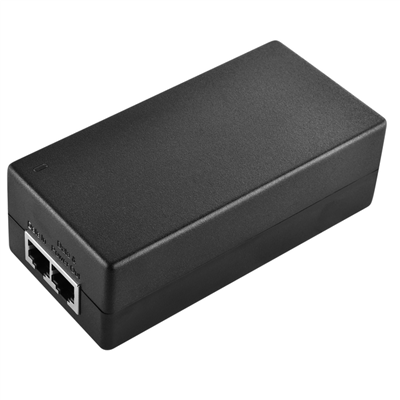
PoE injectors are available in single-port, 2-port, 4-port, 8-port, 12-port, 16-port, etc. If there is only one powered device, choose a single-port PoE injector. If there are multiple PoE end devices, consider a 2-port PoE injector to ensure the number of PoE ports matches. When choosing a multi-port PoE injector, it is best to spare 1-2 ports according to the actual situation as an emergency backup for the future.
Choose the active PoE injector
It is necessary to ensure that the PoE injector and the connected powered device operate at the same voltage. Typically, the voltage of active PoE devices (IEEE 802.3af/at or IEEE 802.3bt) is DC 44-57V, while passive PoE devices operate at the voltage of DC 18-48V. Two devices connected with mismatched voltage values may cause damage to the device. Therefore, it is recommended to use active PoE devices considering their safety. General, the IEEE 802.3bt is backward compatible with 802.3af/at devices.
The output power of the PoE injector is greater than the total rated power of the PD
The power of PD devices (IP cameras, IP phones, etc.) ranges from low to high. When choosing a matching PSE, you should use a PoE injector whose output power is greater than the rated power of the PD. If you use a multi-port PoE injector, then the total rated power of all PDs should be less than the actual total output power of the PoE injector to avoid overload.
Network transmission rate
The data transmission rate of the PoE injector is mainly 10/100Base-T adaptive and 10/100/1000Base-T adaptive. If you need a gigabit transmission rate, you must choose a gigabit injector, or the transmission rate will automatically drop.
FAQ
Q: How does PoE reduce installation costs?
Q: How are PoE deployments more responsive?
Q: Why is PoE installation safer?
Q: What are PoE data-gathering capabilities?
Q: How does PoE enhance productivity?
Q: What is the maximum distance of PoE?
Q: How much power can PoE devices supply?
Q: How does PoE power devices?
Q: How do I know if my ethernet cable supports PoE?
Q: Are all ethernet cables PoE?
Q: Do all cables (Cat6, Cat6a, Cat7, Cat8) support PoE?
Q: What is a Midspan POE Injector?
Q: How safe is PoE?
Q: Is PoE useful in extending network reach?
Q: Will PoE hurt non-PoE devices?
Q: Can PoE deliver an Uninterruptable Power Supply?
Q: What is the difference between PoE+ and PoE ++?
Q: How much PoE do I need?
Q: Is Cat6 ok for PoE?
Q: What is the difference between a PoE and an Ethernet port?
Dongguan KaiWin Electronics Co., Ltd. is one of the leading poe manufacturers and suppliers in China. We warmly welcome you to buy customized poe made in China here from our factory. For free sample, contact us now.
