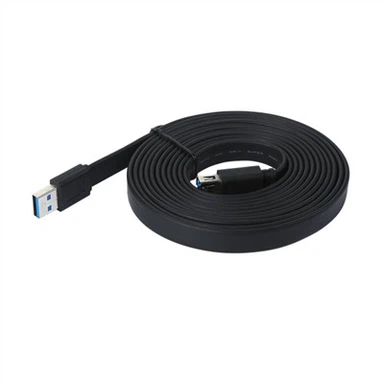
The difference between cable and optical cable
Sep 03, 2022
Cable: When the phone converts the acoustic signal into an electrical signal and transmits it to the switch via the line, the switch transmits the electrical signal directly to the other phone via the line for answering. The transmission line during the call is the cable. The cable is mainly composed of copper core wires. The diameter of the core wire is divided into 0.32mm, 0.4mm and 0.5mm, the larger the diameter, the stronger the communication ability; there are also points according to the number of core wires: 5 pairs, 10 pairs, 20 pairs, 50 pairs, 100 pairs, 200 pairs Wait, the logarithm mentioned here refers to the maximum number of users that the cable can accommodate; there are also points by package, which I don't know much about. Cable: It is bulky, heavy, and has poor communication capability, so it can only be used for short-range communication.
Optical cable: When the phone converts the acoustic signal into an electrical signal and transmits it to the switch through the line, the switch transmits the electrical signal to the photoelectric conversion device (converts the electrical signal into an optical signal) and transmits it to another photoelectric conversion device through the line ( Convert the optical signal into an electrical signal), and then send it to the switching equipment and answer it on another phone. The line between the two photoelectric conversion devices is the optical cable. It is said that it is only divided into the number of core wires, and the number of core wires is: 4, 6, 8, 12 pairs and so on. Optical cable: It has the advantages of small size, small weight, low cost, large communication capacity and strong communication ability. Due to many factors, it is only used for long distance and point-to-point (ie, two exchange rooms) communication transmission. The difference between them: The inside of the cable is copper core wire; the inside of the optical cable is glass fiber. Optical cable Communication optical cable is a kind of communication line in which a certain number of optical fibers form a cable core according to a certain method, which is covered with a sheath, and some are also covered with an outer sheath to realize the transmission of optical signals. Field tests have been carried out in Shanghai, Beijing, Wuhan and other places successively. Soon after, it was used as an inter-office trunk in the local telephone network. After 1984, it was gradually used for long-distance lines, and single-mode fiber was used. Communication optical cables have larger transmission capacity than copper cables, long relay distance, small size, light weight, and no electromagnetic interference. Since 1976, they have developed into long-distance trunk lines, urban relays, offshore and transoceanic submarine communications , as well as the backbone of wired transmission lines for local area networks, private networks, etc., and began to develop into the field of user loop distribution networks in the city, providing transmission lines for fiber-to-the-home and broadband integrated service digital networks. The cable is usually a rope-like cable formed by twisting several or several groups of conductors [at least two in each group]. Each group of conductors is insulated from each other and often twisted around a center. Insulating cover; especially for submarine cables. First: there are differences in materials. The cable is made of metal material (mostly copper, aluminum) as the conductor; the optical cable is made of glass fiber as the conductor. Second: there is a difference in the transmission signal. Cables transmit electrical signals. Optical cables transmit optical signals. Third: There are differences in the scope of application. Cables are now mostly used for energy transmission and low-end data information transmission (such as telephone). Optical cables are mostly used for data transmission.